What Happened to King Louis Xvi During the French Revolution?

The execution of Louis Sixteen past guillotine, a major event of the French Revolution, took identify publicly on 21 January 1793 at the Place de la Révolution ("Revolution Square", formerly Place Louis 15, and renamed Place de la Concorde in 1795) in Paris. At a trial on 17 January 1793, the National Convention had convicted the king of loftier treason in a nigh-unanimous vote; while no one voted "not guilty", several deputies abstained. Ultimately, they condemned him to death by a simple bulk. The execution was performed four days afterward by Charles-Henri Sanson, then High Executioner of the French First Republic and previously royal executioner under Louis.
Often viewed as a turning point in both French and European history, Louis'due south death inspired diverse reactions around the world. To some, his decease at the easily of his quondam subjects symbolised the long-awaited end of an unbroken thousand-year period of absolute monarchy in French republic and the true beginning of commonwealth within the nation, although Louis would not be the terminal king of France. Others (even some who had supported major political reform) condemned the execution as an act of senseless bloodshed and saw information technology as a sign that French republic had devolved into a state of fierce, amoral chaos.
Louis' decease emboldened revolutionaries within France, who would go on to modify the state's political and social structure radically over the adjacent several years. Nine months after Louis' expiry, his married woman Marie Antoinette, herself the one-time queen of France, met her own decease at the guillotine at the same location in Paris.
Journey to the Place de la Révolution [edit]
Louis XVI awoke early in the morning. Afterward dressing with the help of his valet Jean-Baptiste Cléry, he went to encounter with the non-juring Irish priest Henry Essex Edgeworth to make his confession. He heard his concluding Mass, served by Cléry, and received Communion. The Mass requisites were provided by special direction of the authorities. On Edgeworth'due south advice, Louis avoided a last bye scene with his family unit. At 7 o'clock he confided his last wishes to the priest. His purple seal was to go to the Dauphin and his hymeneals ring to the Queen. Afterwards receiving the priest's blessing, he went to meet Antoine Joseph Santerre, Commander of the Guard. A green carriage waited in the second court. He seated himself in it with the priest, with two militiamen sitting contrary them. The wagon left the Temple at approximately 9 o'clock. For more than than an hour the wagon, preceded by drummers playing to drown out any support for the King and escorted by a cavalry troop with fatigued sabres, made its manner through Paris forth a route lined with 80,000 men-at-arms (soldiers of the National Guard and sans-culottes).
In the neighbourhood of the present-24-hour interval rue de Cléry, the Baron de Batz, a supporter of the Royal family who had financed the flight to Varennes, had summoned 300 Royalists to enable the King'southward escape. Louis was to be hidden in a firm in the rue de Cléry belonging to the Count of Marsan. The Baron leaped frontward calling "Follow me, my friends, permit us save the Rex!", but his associates had been denounced and only a few had been able to turn up. Iii of them were killed, simply de Batz managed to escape.
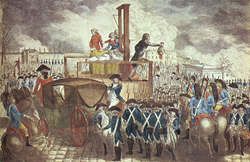
At 10 o'clock, the carriage arrived at Place de la Révolution and proceeded to an area where a scaffold had been erected, in a space surrounded by guns and drums, and by a crowd carrying pikes and bayonets.
Execution [edit]
Afterwards initially refusing to permit Sanson and his administration to bind his hands together, Louis XVI relented when Sanson proposed to use his handkerchief instead of rope. The executioner's men cut the king'southward hair, removed his shirt'south neckband, and followed him up the scaffold. Upon the platform, Louis proclaimed his innocence to the crowd and expressed his concern for the future of France. He tried to give an extensive speech communication, but a drum roll was ordered by Antoine Joseph Santerre and the resulting noise made his last words difficult to understand.
The executioners fastened him to the guillotine's demote (bascule), positioning his neck beneath the device's yoke (lunette) to hold it in identify, and the blade swiftly decapitated him. Sanson grabbed his severed head out of the receptacle into which it fell and exhibited information technology to the cheering crowd. According to 1 witness study, the blade did non sever his neck just instead cut through the back of his skull and into his jaw.[1] Some accounts land that members of the oversupply rushed towards the scaffold with handkerchiefs to dip them in his blood and keep equally souvenirs.
Witness quotes [edit]

"The Death of Louis Xvi King of French republic from an English engraving, published 1798.
Henry Essex Edgeworth [edit]
Edgeworth, Louis' Irish confessor, wrote in his memoirs:
The path leading to the scaffold was extremely rough and hard to laissez passer; the Rex was obliged to lean on my arm, and from the slowness with which he proceeded, I feared for a moment that his courage might neglect; but what was my astonishment, when arrived at the last stride, I felt that he suddenly let get my arm, and I saw him cross with a business firm human foot the breadth of the whole scaffold; silence, past his expect lone, fifteen or xx drums that were placed opposite to me; and in a vocalism so loud, that it must take been heard at the Pont Tournant, I heard him pronounce distinctly these memorable words: "I dice innocent of all the crimes laid to my charge; I Pardon those who accept occasioned my decease; and I pray to God that the blood you are going to shed may never be visited on France."[ii]
Printing of the day [edit]
The 13 Feb issue of the Thermomètre du jour ('Daily Thermometer'), a moderate Republican paper, described the Male monarch equally shouting "I am lost!", citing as its source the executioner, Charles-Henri Sanson.[ citation needed ]
Charles-Henri Sanson [edit]
The executioner Charles-Henri Sanson responded to the story past offering his ain version of events in a letter dated 20 Feb 1793. The account of Sanson states:
Arriving at the foot of the guillotine, Louis XVI looked for a moment at the instruments of his execution and asked Sanson why the drums had stopped chirapsia. He came forward to speak, but at that place were shouts to the executioners to become on with their piece of work. As he was strapped downwardly, he exclaimed "My people, I die innocent!" And so, turning towards his executioners, Louis XVI declared "Gentlemen, I am innocent of everything of which I am accused. I hope that my blood may cement the adept fortune of the French." The blade fell. It was 10:22 am. One of the administration of Sanson showed the head of Louis Sixteen to the people, whereupon a huge weep of "Vive la Nation! Vive la République!" arose and an artillery salute rang out which reached the ears of the imprisoned Purple family.
In his letter, published along with its French mistakes in the Thermomètre of Th, 21 Feb 1793, Sanson emphasises that the King "bore all this with a sophistication and a compactness which has surprised united states of america all. I remained strongly convinced that he derived this firmness from the principles of the religion by which he seemed penetrated and persuaded as no other man."
Henri Sanson [edit]
In his Causeries, Alexandre Dumas refers to a meeting circa 1830 with Henri Sanson, eldest son of Charles-Henri Sanson, who had besides been present at the execution.
"Now then, y'all were saying you wanted something, Monsieur Dumas?"
"You lot know how much playwrights need accurate information, Monsieur Sanson. The moment may come for me to put Louis XVI on the stage. How much truth is in that location in the story of the wrestling tour between him and your father's administration at the human foot of the scaffold?"
"Oh, I can tell you that, Monsieur, I was there."
"I know, that'south why it is you I'm request."
"Well heed. The King had been driven to the scaffold in his ain carriage and his hands were free. At the foot of the scaffold nosotros decided to necktie his hands, but less because we feared that he might defend himself than because we idea he might past an involuntary movement spoil his execution or brand it more than painful. So 1 assistant waited with a rope, while another said to him 'It is necessary to tie your easily'. On hearing these unexpected words, at the unexpected sight of that rope, Louis Sixteen made an involuntary gesture of repulsion. 'Never!' he cried, 'never!' and pushed dorsum the human belongings the rope. The other 3 assistants, believing that a struggle was imminent, dashed forwards. That is the explanation of the moment of confusion interpreted afterward their fashion by the historians. It was then that my father approached and said, in the almost respectful tone of phonation imaginable, 'With a handkerchief, Sire'. At the word 'Sire', which he had non heard for so long, Louis XVI winced, and at the same moment his confessor had addressed a few words to him from the carriage,[three] said 'And then exist it, so, that too, my God!' and held out his hands."
Henri Sanson was appointed Executioner of Paris from April 1793, and would after execute Marie Antoinette.[ commendation needed ]
Leboucher [edit]
Speaking to Victor Hugo in 1840, a homo chosen Leboucher, who had arrived in Paris from Bourges in December 1792 and was present at the execution of Louis XVI, recalled vividly:
Here are some unknown details. The executioners numbered four; two only performed the execution; the third stayed at the foot of the ladder, and the 4th was on the carriage which was to convey the King's body to the Madeleine Cemetery and which was waiting a few feet from the scaffold.
The executioners wore breeches, coats in the French style equally the Revolution had modified it, and three-cornered hats with enormous tri-color cockades.
They executed the King with their hats on, and it was without taking his hat off that Samson, [sic] seizing by the pilus the severed caput of Louis 16., showed information technology to the people, and for a few moments allow the blood from it trickle upon the scaffold.[4]
Louis-Sébastien Mercier [edit]
In Le nouveau Paris, Mercier describes the execution of Louis XVI in these words:
... is this actually the same man that I see beingness jostled by four assistant executioners, forcibly undressed, his voice drowned out past the drums, trussed to a plank, still struggling, and receiving the heavy bract so badly that the cut does not go through his neck, only through the dorsum of his caput and his jaw, horribly?
Jacques de Molay [edit]
A pop just apocryphal legend holds that as soon as the guillotine barbarous, an anonymous Freemason leaped on the scaffolding, plunged his hand into the blood, splashed drips of it onto the crown, and shouted, "Jacques de Molay, tu es vengé!" (usually translated as, "Jacques de Molay, thou art avenged"). De Molay (died 1314), the last Grand Chief of the Knights Templar, had reportedly cursed Louis' ancestor Philip the Fair, after the latter had sentenced him to burn at the stake based on false confessions. The story spread widely and the phrase remains in use today to point the triumph of reason and logic over "religious superstition".[5]
Burial in the cemetery of the Madeleine [edit]
The body of Louis 16 was immediately transported to the old Church of the Madeleine (demolished in 1799), since the legislation in force forbade burying of his remains beside those of his father, the Dauphin Louis de France, at Sens. Ii curates who had sworn fealty to the Revolution held a brusque memorial service at the church building. 1 of them, Damoureau, stated in show:
Arriving at the cemetery, I called for silence. A detachment of Gendarmes showed u.s.a. the torso. Information technology was clothed in a white vest and grey silk breeches with matching stockings. We chanted Vespers and the service for the expressionless. In pursuance of an executive order, the body lying in its open bury was thrown onto a bed of quicklime at the lesser of the pit and covered past ane of world, the whole being firmly and thoroughly tamped downwards. Louis 16'southward head was placed at his feet.
On 21 January 1815 Louis 16 and his married woman's remains were re-buried in the Basilica of Saint-Denis where in 1816 his brother, Rex Louis Xviii, had a funerary monument erected past Edme Gaulle.
Today [edit]
The surface area where Louis 16 and later (16 Oct 1793) Marie Antoinette were buried, in the churchyard of St. Mary Magdaleine's, is today the "Square Louis Xvi" greenspace, containing the classically self-effacing Expiatory Chapel completed in 1826 during the reign of Louis's youngest blood brother Charles X. The crypt altar stands in a higher place the exact spot where the remains of the Regal couple were originally laid to rest. The chapel narrowly escaped destruction on politico-ideological grounds during the violently anti-clerical period at the beginning of the 20th century.
Bibliography [edit]
- Necker, Anne Louise Germaine, Considerations on the principal events of the French Revolution (1818)
- Hugo, Victor, The Memoirs of Victor Hugo (1899)
- Thompson, J.Grand., English language Witnesses of the French Revolution (1938)
Paul and Pierrette Girault de Coursac accept written a number of works on Louis 16, including:
- Louis Sixteen, Roi Martyr (1982) Tequi
- Louis XVI, united nations Visage retrouvé (1990) O.E.I.L.
Notes [edit]
- ^ Stephen Clarke, The French Revolution & what went wrong, Century, 2018, p.452, ISBN 9781780895512.
- ^ From his Memoirs, published 1815.
- ^ Father Edgeworth had reminded the King that on Skillful Friday Jesus had offered his hands to be tied.
- ^ "The Memoirs of Victor Hugo".
- ^ DuQuette, Lon Milo (2006). The Fundamental to Solomon'southward Key: Secrets of Magic and Masonry. CCC Publishing. pp. 47–48. ISBN978-1-888729-fourteen-half-dozen.
Source: https://en.wikipedia.org/wiki/Execution_of_Louis_XVI
0 Response to "What Happened to King Louis Xvi During the French Revolution?"
Postar um comentário